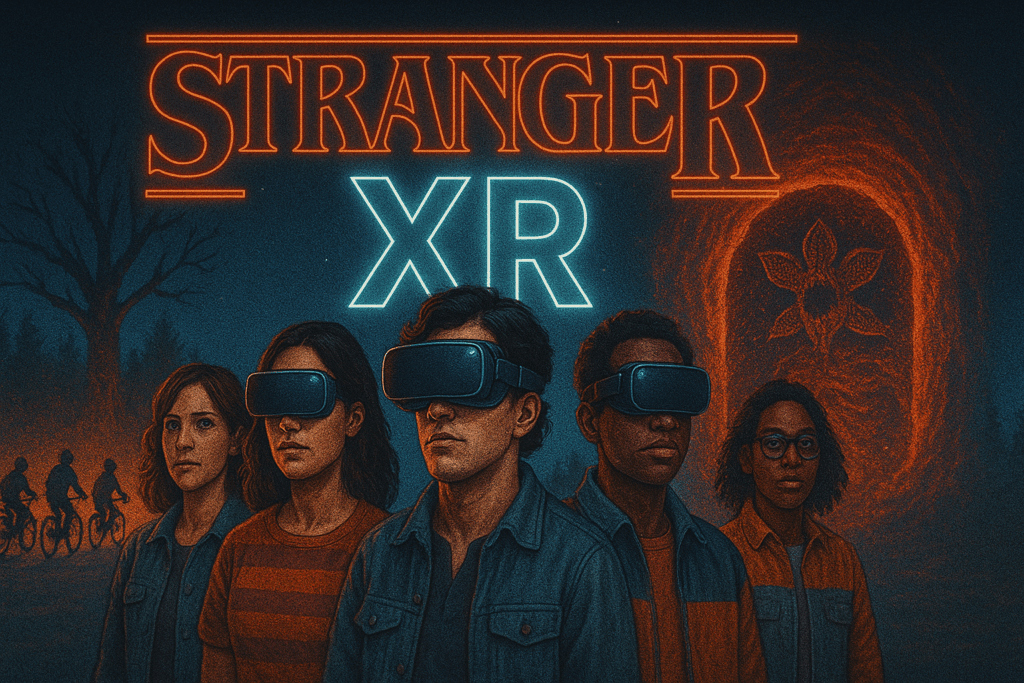
Stranger Things, 80s nostalgia and why immersive tech feels oddly familiar
Confession: I’m a child of the 80s.
I grew up on a steady diet of a commodore 64, pacman, walkman, VHS, arcade machines, care bears, neon stationery, Goonies and big TVs with huge backs and much more. So when Stranger Things arrived, it didn’t just feel like a show, it felt like someone had opened a portal straight back into my childhood.
The Upside Down in Stranger Things is a shadow reality that is accessible through the right portal. Which, when you think about it, seems a lot like Extended Reality (XR)
The Upside Down as a (slightly slimier) version of XR
The hit show on Netflix, Stranger Things has returned for its final fifth season.
In Stranger Things, the Upside Down is:
- Always there, layered over the existing world
- Invisible to most people
- Accessible through specific gateways
- Full of strange creatures and unexpected dangers
In XR, whether that’s VR, AR or MR we’re also building:
- Layers of reality that exist alongside the physical world
- Experiences that only appear when you put on the right headset or hold up your phone
- Portals into new environments: a virtual office, a training simulator, a mixed-reality game on your kitchen table
The big difference, thankfully, is that XR doesn’t usually come with Demogorgons, well I suppose it does if it’s a Stranger Things XR game.
But for those of us who grew up in the 80s, XR might feel intuitive because we’ve been training for it our whole lives:
- Swapping game cartridges could equate to switching apps
- Arcade machines could be comparable with shared immersive spaces
- Rewinding and fast-forwarding “Back to the Future” on VHS, imagining different timelines and “what if” futures, was basically early worldbuilding training for our brain
XR just turns those imagined worlds into something you can see, hear and interact with.
From Hawkins basements to headsets: why this matters for work
It’s easy to file XR under “fun stuff” games and entertainment.
But just like the kids in Hawkins discover the Upside Down is connected to everything, XR is quietly wiring itself into work, learning and careers:
- Virtual Reality is being used for soft-skills training, safety exercises and complex procedures
- Augmented Reality overlays instructions, data and 3D models onto real-world equipment
- Mixed Reality lets teams collaborate around the same holographic model, even if they’re on different continents.
XR isn’t just the next entertainment platform; it can be workspace, not a replacement for the real world, but an alternative and complementary space where work can actually happen.
We’ve already moved from in-person communication in physical offices to virtual platforms like Teams and Zoom. In the coming years, immersive portals might become more commonplace, for example:
- Simulated workplaces where you can safely try a new career
- Immersive training environments that feel more like playing than being lectured at
- Virtual project spaces where freelancers and teams from all over the world can collaborate as if they’re in the same room
It’s the Upside Down, but for good.
Why nostalgia might be XR’s secret superpower
Being a child of the 80s actually helps here.
We remember what it felt like the first time we:
- Saw 3D graphics that didn’t look like chunky blocks
- Plugged in a games console and disappeared into another world for hours
- Watched films like Tron or Blade Runner and thought: “Imagine if that was real…”
XR is basically the grown-up, upgraded version of those fantasies.
The real Upside Down: a flipped model of work
In Stranger Things, the Upside Down is our world but flipped.
XR gives us a chance to flip things too. For example:
- Instead of choosing a career from a list, you can step into different roles in VR and see what fits
- Instead of reading a PDF about safety, you can practice in a simulated environment
- Instead of “you must be in this location, at this time, with this company”, work can become more fluid and location-agnostic
Closing the portal
XR isn’t perfect. The hardware still needs work. The content ecosystem is evolving. And no, your next team meeting doesn’t have to happen in a virtual 80s arcade (although… now I’ve said it, that would be interesting to try).
But for those of us who grew up in the glow of the old style TVs and arcade screens, the fact we can now literally create layered realities feels less like sci-fi and more like a natural sequel.
The question isn’t “Is XR just hype?” It’s “What kind of worlds do we want to build on top of this one and who gets to go through the portal?”
If you’re curious about how XR could help people test-drive careers, learn new skills or rethink what “workplace” even means, that’s a project I’m currently working on and you can find out more information here.
And if you’re also a fellow child of the 80, you already know, the adventure really starts when someone says, “Don’t go in there.”
We go anyway.