The Future Career Studio: A Concept I Can’t Stop Thinking About
It’s 8:12am on a 1st February 2026, and Eva is already on her second career.
Not her second job but her second career experiment of the week.
She’s 38, mid-career, juggling a family, a mortgage, anda mix of boredom and anxiety that comes from doing “respectable” work that doesn’t quite fit anymore. A few years ago, she would have spent months doom-scrolling job boards, second-guessing everything.
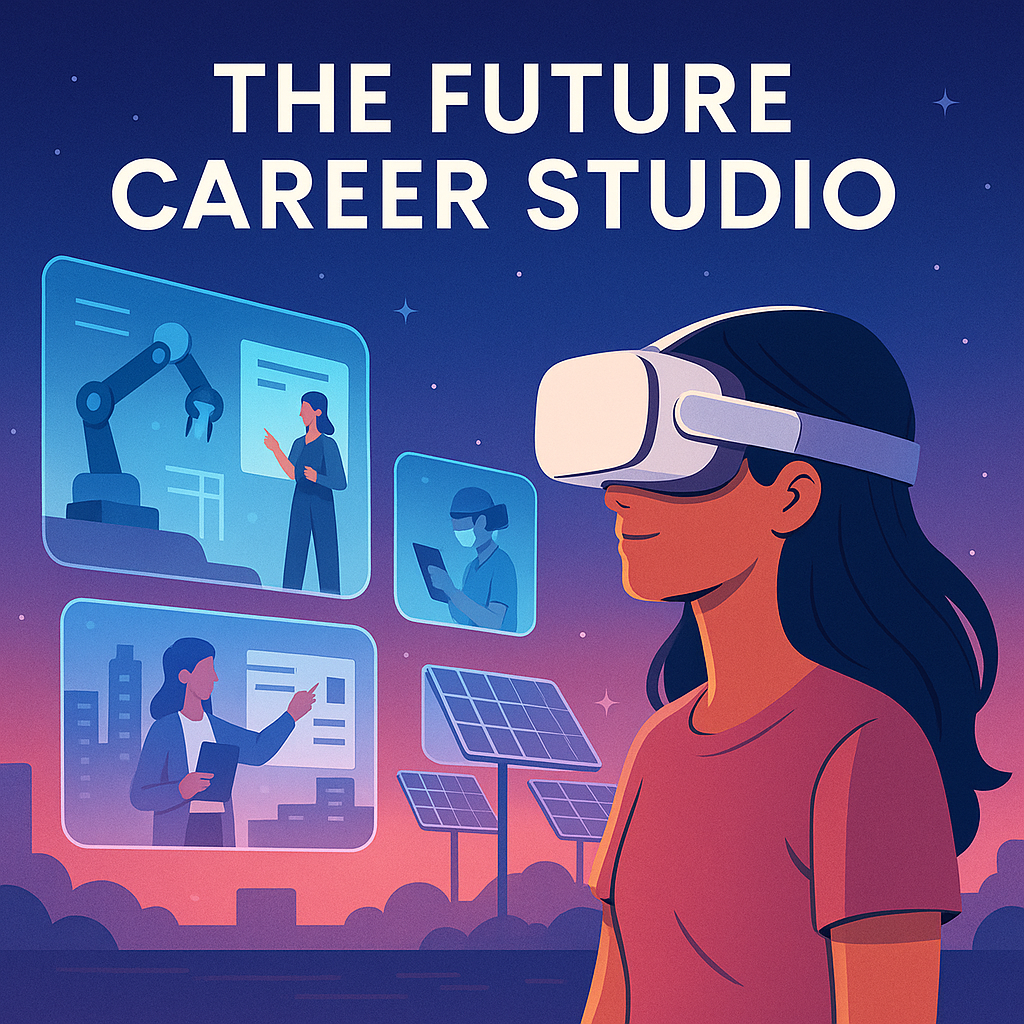
Today, she puts on a VR headset instead.
She logs into something that Xplorient has been quietly building towards for years:
A Future Career Studio.
A place where you don’t just read about a job or watch a webinar.
You are immersed in it.
You try it on.
You see how the work feels.
You see how you feel.
And then, with the help of AI and stellar design, you turn those experiments into real-world decisions.
This is the concept I can’t stop thinking about for Xplorient.
Let me walk you through a day in the life.
09:02 – The check-in: “What do you want to explore today?”
Eva logs into Xplorient’s Future Career Studio from her kitchen table.
The first thing she sees isn’t a dashboard full of charts, it is a simple question floating in an airy, calming virtual space:
“What do you want to explore today?”
She has done the basics already:
- Uploaded her CV/LinkedIn profile
- Synced some skills data from learning platforms
- Answered questions about her values, energy, constraints and non-negotiables
The system has a sense of who she is:
- 10+ years in operations and project delivery
- Am nterest in design and sustainability
- Two kids, limited time, no desire to burn everything down and start from zero
Today she answers:
“What if I moved into sustainability consulting, but kept some of my project skills?”
Her AI career guide appears beside her, not as a cheesy avatar, but as a calm, personable voice and a few simple visual cues.
“Okay, Eva. Let’s explore three worlds:
- Sustainability consulting in a large global firm
- Sustainability in a mid-sized company you already know
- A portfolio path: part-time role + freelance projects
We’ll try short simulations, then reflect. Are you ready?”
She nods. The studio lights dim. The first portal opens.
09:15 – World 1: Inside a sustainability consulting pitch
In an instance, Eva is standing in a virtual client boardroom.
There’s a nervous energy in the room. Beside her, two colleagues which are AI-driven characters represent a strategy partner and a data specialist. Across the virtual table, a panel of executives from a fictional (but realistic) manufacturing company facing pressure to decarbonise.
The scenario is built from real world data and trends:
- Typical client objections
- Common data challenges
- Political dynamics that don’t show up on job descriptions
Her task?
To help steer the conversation. Ask questions. Shape the proposal.
She isn’t alone, subtle prompts appear in her field of view:
- “Try clarifying what success looks like for them.”
- “Ask about constraints such as budget, timeline, internal champions.
- “Listen for emotional cues, who seems resistant?”
She speaks. The execs respond. The conversation branches in different directions depending on her choices.
Ten minutes in, she feels something important:
- Does she enjoy this?
- Is she energised by the complexity?
- Or exhausted by the politics?
At the end of the scenario, the scene gently freezes. A quiet summary appears:
“You quickly established trust and reframed ‘cost’ as ‘investment’.
You hesitated when internal politics emerged.
Emotional state, you seemed engaged but slightly anxious.
Do you want to go deeper into this world another day?”
She decides not to explore further and portal one fades.
10:02 – World 2: Sustainability inside a mid-sized company
Next, Eva steps into a different world: a mid-sized consumer goods company.
She’s not a consultant now; she’s the internal sustainability lead.
In this simulation, she’s not in a boardroom, she’s moving through a series of quick, everyday moments:
- Negotiating with a procurement manager who’s sick of “new initiatives”
- Discussing trade-offs with finance over the cost of greener materials
- Preparing a simple story for the CEO, what’s working, what’s not, and what needs a decision
The studio isn’t trying to give her a “perfect” view of the role. It deliberately shows both:
- The rewarding parts: small wins, influence, mission
- The frustrating parts: resistance, compromise, bureaucracy
At one point, an internal stakeholder snaps at her:
“We don’t have time for this. Just tell me the minimum we need to do.”
The system logs her reaction: her voice, her choices, her heart rate if she’s opted in.
After the scenario, her AI guide gently debriefs with her in a quiet virtual space that looks nothing like an office:
“You stayed calm under pressure.
You shifted the conversation to shared goals.
You seemed more emotionally grounded in this environment than in the consulting scenario. Interesting.”
Eva notices it too that she liked being inside the company, not always on the outside pitching.
11:07 – World 3: The portfolio path
The third world is less defined, because so is the path.
Here, the Future Career Studio does something different, instead of a single “job world”, it offers a montage of days and weeks, stitched together from real patterns of portfolio workers:
- A few days a week in a part-time sustainability role
- Occasional freelance projects for purpose-led startups
- Time blocked for learning, family, deep work
The simulation shows calendars, not just characters.
It lets her “feel into” rhythms:
- How does it feel to switch contexts?
- How does variable income land with her?
- Does she like the mix of autonomy and uncertainty?
She isn’t just watching. She makes decisions:
- Which projects to accept
- How to price her time
- When to say no without guilt
The system keeps asking subtle, reflective questions:
“How did that choice feel?”
“What worried you most in this sequence?”
“What energised you?”
By lunchtime, she hasn’t “chosen” a career.
But she has a pros-and-cons list supported by data.
12:30 – The reflection: “What did today teach you?”
After a break, Eva returns to the studio for a reflection session.
Her AI guide summarises, not just in metrics:
“Based on today’s explorations:
- You seemed energised by working on sustainability from within an organisation, with long-term relationships.
- You enjoyed complex conversations, but preferred ongoing collaboration to one-off pitches.
- The portfolio path appealed, but income variability spiked your stress.
Would you like to explore:
- Internal roles that blend sustainability with operations?
- Or a ‘safer’ bridge into a portfolio path with a guaranteed base income?”
This is where the Future Career Studio blurs into the real world.
On a side panel, she now sees:
- Real job examples that roughly match the patterns she liked
- Skills gaps, with concrete learning suggestions
- A “small experiment” button: things she can try in the next 30 days without quitting anything
Things like:
- “Shadow a sustainability lead in your current company for a day.”
- “Run a small internal project to measure and improve one process.”
- “Take a short course on impact measurement and present your learnings to your team.”
The studio’s core philosophy is simple:
Don’t just fantasise about a new career.
Prototype it. Safely. Iteratively.
The simulations are the door.
The real world is where the story actually unfolds.
Why this concept matters to me
I keep coming back to the idea of a Future Career Studio because our current system is, frankly, not working for a lot of people:
- People are told to “follow their passion” with almost no safe way to test anything.
- Careers advice often collapses into personality quizzes and generic job lists.
- Job descriptions are poor proxies for what a role feels like day-to-day.
- Mid-career professionals feel stuck between “stay and settle” or “burn it all down”.
XR + AI give us a new set of tools:
- XR can simulate environments, conversations and day-to-day realities in a way text never can.
- AI can personalise, adapt, and help interpret what your reactions might mean for your next step.
Put them together thoughtfully and you don’t get a gimmick.
You get a studio.
A place to design your next chapter with more information, more experimentation and more humanity.
This isn’t about predicting your future
A Future Career Studio isn’t there to say:
“You are a [Job Title]. Here is your destiny.”
It’s there to help you:
- Explore multiple worlds, not just one
- Pay attention to how you think, feel and behave in each
- Turn those insights into small, real-world experiments
- Gradually move towards work that fits your life, not someone else’s template
Careers will always be messy.
But the process of exploring them doesn’t have to be blind.
So, what’s next?
At Xplorient, this is the direction I’m obsessed with:
- Building immersive, honest simulations of work
- Pairing them with smart, kind AI guidance
- Integrating all of it with real opportunities and practical next steps
We’re not building a fantasy escape.
We’re building a studio for your future: a place to try things on, learn, and come back again and again as your life evolves.
Because in 2026, I’d love it if more people like Eva could say:
“I didn’t just think about a new career.
I visited it, tested it, and then I built a bridge.”
And if that idea sparks something in you, as a professional, an employer, an educator or a partner, I’d love to continue the conversation.
Would you step into a Future Career Studio? And what’s the first world you’d ask to explore? Share your thoughts in the comments section.